 Skip to main content


Your printer flashes a "Low Toner" warning just as you're preparing an important report. Now you’re wondering how many pages this cartridge should have printed, and why it is already running low?
If you've ever compared toner cartridges, you've probably seen terms like 2,500-page yield or high-yield toner listed on the box. But what do those numbers actually mean? More importantly, how do they affect your printing costs and purchasing decisions?
At Strategic Technology Partners of Texas (STPT), we've spent 40 years helping businesses get the most from their printing environments. With toner costs being high, customers want to better understand toner yield. While it seems straightforward, several factors influence how long a cartridge actually lasts.
In this guide, you'll learn what toner yield means, how manufacturers calculate it, what affects real-world results, and how to maximize the value of every cartridge you purchase.
Short Answer: What Is Toner Yield?
Toner yield is the estimated number of pages a toner cartridge can print before needing replacement. Manufacturers calculate toner yield using standardized testing at 5% page coverage, which helps users compare cartridges and estimate printing costs.
Table of Contents
- What Is Toner Yield?
- How Is Toner Yield Measured?
- What Does 5% Page Coverage Mean?
- Why Doesn't Actual Toner Yield Match the Box?
- What Affects Toner Yield?
- Black vs. Color Toner Yield
- Standard Yield vs. High-Yield vs. Extra-High-Yield Toner
- How Toner Yield Affects Cost Per Page
- Printer Maintenance and Settings: Their Role in Toner Yield
- Tips to Maximize Toner Yield
- Why Toner Yield Matters
- FAQ
What Is Toner Yield?
Toner yield, also called cartridge yield, refers to the estimated number of pages a toner cartridge can print before needing replacement. It’s like a printer’s gas tank; it measures how far you can go before needing a refill.
Printer manufacturers determine toner yield through standardized testing procedures to see how many pages can be printed under specific conditions. These yield ratings provide a useful benchmark for comparing cartridges, forecasting supply costs, and planning replacements.
While toner yield gives you a good starting point, it's important to remember that actual results vary based on what and how you print.
How Is Toner Yield Measured?
Manufacturers measure toner yield using internationally recognized ISO testing standards. These tests print standardized pages under controlled conditions to estimate how many pages a cartridge can produce before running out of toner.
Most printer manufacturers follow standards such as:
- ISO/IEC 19752 for monochrome toner cartridges
- ISO/IEC 19798 for color toner cartridges
These standards create consistency across manufacturers, making it easier to compare cartridge yields from different brands.
What Does 5% Page Coverage Mean?
5% page coverage means only about 5% of a printed page contains toner. A simple email, memo, or business letter often falls near 5% coverage, while graphics, charts, logos, and photos significantly increase toner usage.
The 5% page coverage standard exists because manufacturers need a consistent way to measure toner yield.
Here's what different coverage levels typically look like:
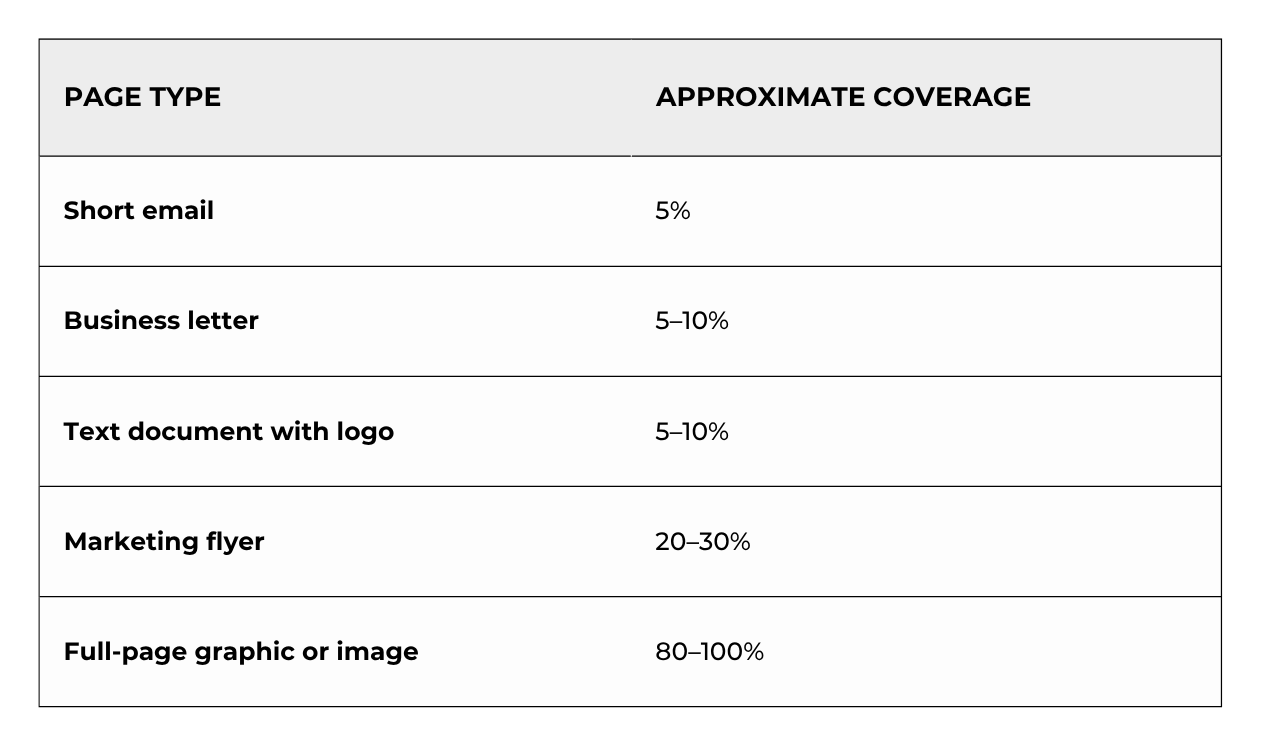
Not every cartridge will print the exact number listed on the box as that number assumes relatively light coverage.
The more toner is placed on each page, the fewer pages the cartridge will ultimately print.
For a deeper dive into coverage percentages and how they impact printing costs, check out our guide on What Is Page Coverage and Why Is It Important?
Why Doesn't Actual Toner Yield Match the Number on the Box?
While most toner yield ratings assume 5% page coverage, things like graphics, photos, color elements, or heavy text coverage can lower your actual yield.
It’s possible that a cartridge rated for 3,000 pages will only produce 2,000 pages in real-world use.
But this doesn’t always mean the cartridge is defective; it just means the printing conditions differ from the testing environment.
Even having an older printer or poor maintenance can affect your actual toner yield.
Yield ratings are more like estimates rather than guarantees.
How to Calculate Toner Longevity
All toners have an estimated lifespan. But if you want to calculate how long your toner will last you, divide the estimated number of printable pages by your average monthly print volume. For example, if your cartridge yields 2,000 pages and your office prints 500 pages per month, the cartridge should last around four months (assuming 5% page coverage).
Modern printers, especially Xerox models, come with built-in features like toner usage monitors or remaining yield estimators that provide real-time insights.
A screenshot from a Xerox printer shows the remaining toner levels

What Affects Toner Yield?
Several factors influence how many pages a cartridge can realistically produce in your print environment.
Page Coverage
Page coverage has the greatest impact on toner consumption. The more toner on your page means fewer total pages per cartridge.
A simple text document uses far less toner than a brochure or report with charges and graphics.
Cartridge Type
OEM toner cartridges typically provide more consistent and higher yields due to precise engineering.
Third-party and remanufactured cartridges can save you money upfront, but may not perform as consistently. Learn more about the types of printer toner here.
Print Quality Settings
High-quality print settings often use more toner than draft or eco mode.
Using standard mode balances quality and efficiency
If you don’t need the highest print quality, selecting lower print settings can stretch cartridge life.
Environmental Conditions
Temperature, humidity, storage conditions, and overall printer health can all affect toner performance.
A properly maintained printer typically uses toner more efficiently and consistently than a poorly maintained device. Learn more about ideal printer environmental conditions here.
Black vs. Color Toner Yield
Black toner cartridges typically deliver higher page yields than color cartridges. This is because monochrome printing uses only one toner supply, while color printing relies on a combination of cyan, magenta, yellow, and black (CMYK) working together.
As a result, color print jobs often consume more toner overall.
Standard Yield vs. High-Yield vs. Extra-High-Yield Toner
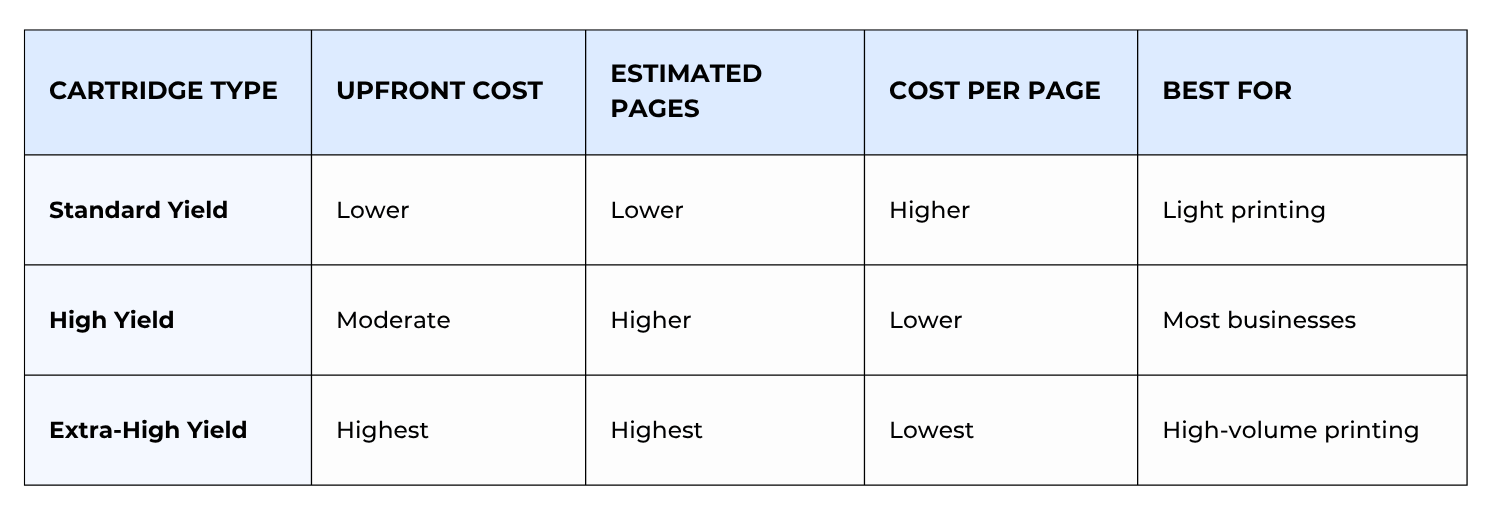
When shopping for toner, you'll often find multiple cartridge options for the same printer.
Is High-Yield Toner Better?
For many businesses, yes.
High-yield cartridges contain more toner and typically reduce cartridge replacement frequency and downtime caused by supply shortages
Although they cost more initially, they often deliver a lower overall cost per page.
How Toner Yield Affects Cost Per Page
Toner yield directly affects cost per page. A cartridge that prints more pages often lowers the cost of each printed page, even if the cartridge costs more upfront.
One of the easiest ways to evaluate toner value is by calculating cost per page (CPP).
Formula:
Cost Per Page = Cartridge Cost ÷ Cartridge Yield
For example:
- Cartridge Cost = $200
- Yield = 10,000 pages
CPP = $0.02 per page
A cartridge with a higher yield often produces a lower CPP, which can significantly reduce printing expenses over time.
If you'd like to calculate your organization's actual printing costs, read our guide: How to Calculate Your Printing Cost Per Page (CPP).
Printer Maintenance and Settings: Their Role in Toner Yield
Printer maintenance plays an important role in cartridge performance.
Dust accumulation, worn components, and outdated firmware can all lead to inefficient toner use. By cleaning your printer and replacing worn parts, you can ensure smoother operation and maximize toner yield.
Your printer settings matter too. Using draft mode or eco-settings reduces toner use while still producing legible documents.
To learn more about improving print efficiency, check out our guide on 5 Best Color Printing Practices.
Tips to Maximize Toner Yield
If you'd like to make every cartridge last longer, these best practices can help:
- Use Toner-Saving Modes: Draft and eco modes reduce toner usage on everyday documents.
- Review Before Printing: Digital proofing helps eliminate unnecessary reprints.
- Choose the Right Cartridge: High-yield cartridges often provide better long-term value for moderate and high-volume environments.
- Maintain Your Equipment: Clean your printer, update firmware, and replace worn parts.
- Monitor Usage: Tools like print management software help identify waste, track consumption, and optimize printing behavior.
Key Takeaways
- Toner yield estimates how many pages a cartridge can print.
- Manufacturers calculate yield using standardized 5% page coverage testing.
- Higher page coverage reduces actual cartridge life.
- High-yield cartridges often lower cost per page.
- Proper maintenance and print management help maximize toner usage.
FAQ
Does high-yield toner last longer?
Yes. High-yield cartridges contain more toner than standard-yield cartridges and can print significantly more pages before replacement.
What affects toner yield the most?
Page coverage has the biggest impact on toner yield. Documents with graphics, images, logos, or heavy text coverage use more toner and reduce the total number of pages a cartridge can produce.
How many pages can a toner cartridge print?
It depends on the cartridge model. Some cartridges yield around 1,000 pages, while high-yield business cartridges can print 10,000 pages or more. Refer to the manufacturer's yield rating as a starting point.
How do I know which toner cartridge to buy?
First, identify your printer model. Then compare standard-yield and high-yield options based on your monthly print volume, budget, and printing needs.
Understanding Toner Yield Helps You Control Printing Costs
Knowing your toner yield is a good way to start optimizing your print environment.
Now that you understand how toner yield works, what affects it, and how it connects to cost per page, you can make smarter purchasing decisions and reduce unnecessary printing expenses.
If your organization prints thousands of pages each month, Managed Print Services or automatic toner replenishment can help reduce supply costs and minimize downtime.
At Strategic Technology Partners of Texas, we’re here to help you lower costs, improve efficiency, or simply understand your printing data better. We're here to help you make informed decisions that support your business.
