 Skip to main content

Page coverage is one of the most important printing concepts most people have never heard of.
If you've ever purchased a toner cartridge that claimed it could print thousands of pages, only to find yourself replacing it much sooner than expected, page coverage is often the reason why.
The amount of toner or ink used on each page directly affects how long your supplies last, how much your printing costs, and whether the cartridge yield listed on the box is realistic for your how you actually print.
At Strategic Technology Partners of Texas, we've found that one of the most common sources of confusion is page coverage and its role in toner consumption.
In this guide, we'll explain what page coverage is, what 5% page coverage means, what it actually looks like, and why understanding it can help you make smarter printing decisions.
Short Answer: What is Page Coverage?
Page coverage is the percentage of a printed page that contains toner or ink. Manufacturers use page coverage to estimate toner yield, compare cartridge performance, and calculate printing costs. Most toner and ink cartridge yields are tested using 5% page coverage.
Table of Contents
- What Is Page Coverage?
- What Is 5% Page Coverage?
- What Does 5% Page Coverage Look Like?
- Why Do Manufacturers Use 5% Page Coverage?
- Page Coverage Example
- How Are Page Coverage and Toner Yield Related?
- Why Is Page Coverage Important?
- How Can You Make Your Supplies Last Longer?
- Key Takeaways
- FAQ
What Is Page Coverage?
Page coverage is how much of a page is covered with toner or ink.
When printer manufacturers publish cartridge yields, they don't simply estimate how many pages a cartridge can print. Instead, they calculate cartridge yield using a standardized amount of toner coverage on each page.
That's why you often see statements such as:
"Up to 6,000 pages at 5% page coverage."
The key phrase is "5% page coverage."
Without understanding what that means, it can be hard to know whether the yield listed on the cartridge box reflects your real-world printing habits.
What Is 5% Page Coverage?
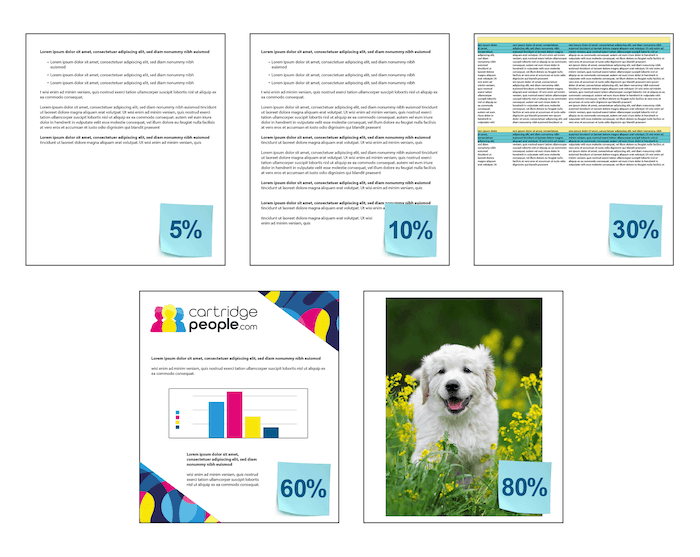
5% page coverage means approximately 5% of a sheet of paper contains toner or ink. A page with 5% coverage typically looks like a short email, memo, or simple business letter with large areas of white space remaining.
The 5% page coverage standard was established by the International Organization for Standardization (ISO).
The purpose of the standard is to provide a consistent way for manufacturers to measure and compare cartridge yields.
The purpose of the standard is to estimate a cartridge's page yield (also called cartridge yield or toner yield), which is the number of pages a toner or ink cartridge can print before needing replacement.
Without a common testing standard, one manufacturer could test using a page with very little toner while another could test using a page with heavy graphics. Yield ratings would become almost impossible to compare.
By using 5% page coverage, manufacturers have a common benchmark for estimating how many pages a cartridge can print.
What Does 5% Page Coverage Look Like?
A page with 5% coverage usually contains only a few paragraphs of text with little or no graphics, photos, logos, or colored elements. Most business documents exceed 5% coverage.
One mistake you can make about cartridge yield is to assume most documents are like the 5% example used during testing.
The reality is that your everyday documents use a lot more toner.
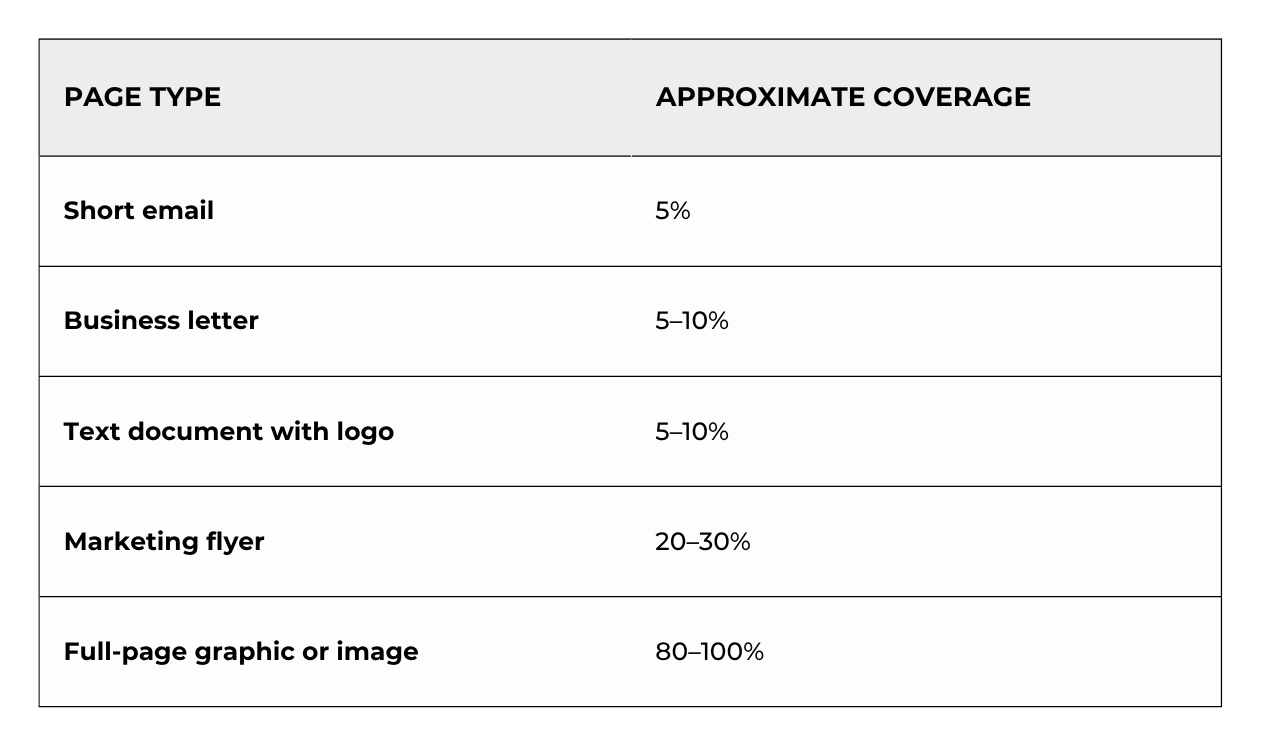
Notice how quickly coverage increases once graphics, logos, photos, or color elements are added.
This is why many users never reach the maximum page yield listed on their toner cartridges.
What does 5%-page coverage look like? See the graphic below, courtesy of LD Products, for a visual representation of how toner or ink covering 5% of the page looks compared to other percentages:
Why Do Manufacturers Use 5% Page Coverage?
Manufacturers use 5% page coverage because it creates a standardized way to measure cartridge yield. It allows consumers to compare toner and ink cartridges across brands and models.
The 5% standard benefits consumers because it creates consistency.
For example, top printer brands like Xerox, Canon, Brother, and HP use it.
Because the testing method is standardized, users can compare cartridge yields more accurately across different manufacturers.
Page Coverage Example
Let's look at a practical example using the Xerox VersaLink C415.
This printer uses four toner cartridges:
- Cyan
- Magenta
- Yellow
- Black
Each Cyan high-capacity toner cartridge is rated for approximately 7,000 pages at 5% page coverage.
However, based on the actual documents you print, your exact page yield will vary.
Higher page coverage reduces cartridge yield. If you print more graphic-heavy, colorful documents, toner consumption increases, and cartridges print fewer total pages.
A presentation with charts, logos, and graphics might use two to four times more toner than a simple business letter.
A full-page photo can use even more toner than either of those examples.
So, while the cartridge yield rating gives you a good approximation, the contents of your prints will largely determine how long your cartridge will actually last.
How Are Page Coverage and Page Yield Related?
Page coverage directly affects page yield. As page coverage increases, toner usage increases and the total number of pages a cartridge can print decreases.
Think of page coverage and toner yield as opposite sides of the same equation.
As page coverage goes up:
- Toner consumption goes up.
- Cartridge life goes down.
- Cost per page increases.
As page coverage goes down:
- Toner consumption decreases.
- Cartridge life increases.
- Cost per page decreases.
This is one of the reasons understanding page coverage is so important when evaluating printing costs.
If you'd like a deeper explanation, read our guide on What Is Toner Yield?
Why Is Page Coverage Important?
Understanding page coverage helps you make more informed decisions about your printing environment.
Page coverage matters because:
It affects how long your cartridges last.
The amount of toner used on each page directly impacts cartridge life.
It affects your printing costs.
Higher coverage means higher toner/ink consumption, which often leads to more frequent cartridge replacements.
It helps you evaluate cartridge yields accurately.
Understanding page coverage helps explain why your toner may not last as long as the box suggests.
It helps determine the right supplies for your environment.
Organizations with high-coverage printing often benefit from higher-yield cartridges or managed print solutions.
Simply put, page coverage influences nearly every aspect of your printing costs.
How Can You Make Your Supplies Last Longer?
While you can't eliminate page coverage entirely, you can reduce unnecessary toner consumption.
Review your printing habits.
Ask yourself whether every document truly needs to be printed.
Use digital storage when possible.
Saving invoices, reports, and communications digitally can significantly reduce print volumes.
Use toner-saving modes.
Draft mode and eco settings can reduce toner usage for internal documents.
Wait before replacing low toner cartridges.
Many cartridges continue printing effectively after a low-toner alert appears.
Maintain your printer.
A properly maintained printer often uses supplies more efficiently and produces more consistent output.
Choose the right cartridge.
High-yield cartridges can reduce cost per page and minimize replacement frequency in many environments.
Key Takeaways
- Page coverage measures how much toner or ink appears on a printed page.
- Most manufacturers calculate cartridge yields using 5% page coverage.
- A page with 5% coverage typically looks like a short email or business letter.
- Higher page coverage reduces toner yield and increases printing costs.
- Understanding page coverage helps predict cartridge life and supply expenses.
FAQ
How much is 5% page coverage?
5% page coverage means roughly 5% of a sheet of paper contains toner or ink. It typically resembles a short email, memo, or simple business letter.
What does 5% page coverage look like?
A page with 5% coverage usually contains only a few paragraphs of text with little or no graphics, images, logos, or color elements.
How do you calculate page coverage?
Page coverage can be estimated using printer reporting tools, print management software, or coverage calculators. Most businesses rely on software-generated estimates rather than manual calculations.
Why is page coverage important?
Page coverage affects toner consumption, cartridge yield, printing costs, and the overall cost of operating a printer.
Understanding Page Coverage Helps You Understand Printing Costs
If you've ever wondered why a toner cartridge didn't last as long as expected, page coverage is often the missing piece of the puzzle.
Now that you understand what page coverage is, what 5% page coverage means, and how it affects toner consumption, you're in a much better position to evaluate cartridge yields and predict printing costs more accurately.
The next logical step is understanding how page coverage affects cartridge life. Our guide on What Is Toner Yield? explains how manufacturers calculate yield ratings and why actual results often differ from the number printed on the box.
From there, you can continue to our guide on How to Calculate Your Printing Cost Per Page (CPP) to see how toner usage translates into real-world printing expenses.
At Strategic Technology Partners of Texas, we've helped organizations optimize their printing environments for nearly 40 years. Whether you're evaluating supplies, managing printer costs, or simply trying to understand how your equipment performs, we're here to help you make informed decisions.
